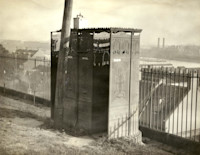
Demolition Photographs 1900 - 1949
Within this section
Accessing Building Application Records | Assessment Books 1845 - 1950 | Citations for Archival Records | Demolition Photographs 1900 - 1949 | Records of Councils Absorbed by Sydney City Council | Sydney Reference Collection
This leaflet has been produced to guide researchers in the use of the albums of Demolition Photographs in the custody of the City of Sydney Archives . It should be read in conjunction with Making the Best Use of the Archives.
These photographs are among the records most heavily used by researchers. They are available online through ArchivePix, the City of Sydney Archives digital photograph bank.
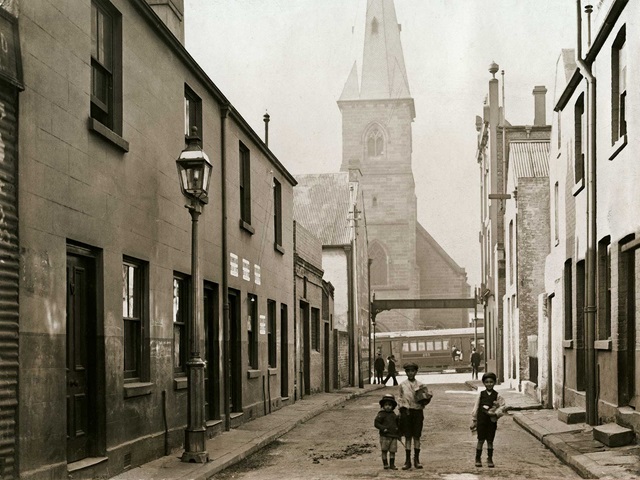
They are a good example of records created originally for specific purposes (to record buildings about to be demolished and to record the construction of Council owned buildings), but that have come to be used by Council and public researchers for many different purposes.
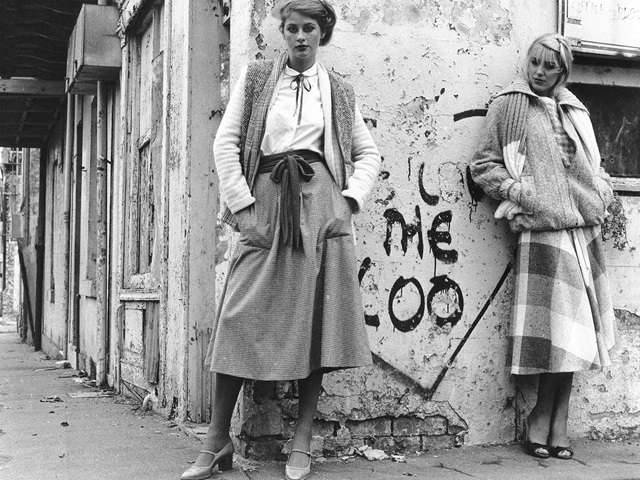
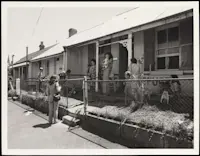
They are of course used to discover what demolished buildings looked like, and to assist with the restoration of Council buildings such as the Queen Victoria Building and the Capitol Theatre, but they have also been used to research and illustrate different kinds of street furniture, vehicles, clothing, advertising signs, iron lacework on buildings, election posters, general vistas of Sydney, and the presence of various communities (such as the Chinese). One of the common features of the photographs is the groups of children (and their parents and pets) who appear in many of them because they spotted the photographer and managed to get into the shot.
The albums have come to be known as the "Demolition Books", but in fact, only the first 15 volumes relate to demolitions of properties and the full title is actually "Condemnations and Demolitions". The other 35 volumes show properties to be compulsorily acquired, and construction and alterations to Council depots, the Fruit, Vegetable, Fish and Poultry Markets, the Pyrmont Power Station and various sub-stations, alterations and additions to the Queen Victoria Building, Council parks, the Moore Park Destructor, streets in Camperdown, the Coffee Palace in Hay and Sussex Streets, the Municipal Garage in Palmer Street, the Hippodrome, plague prevention in Camperdown, decorations and illuminations of the Town Hall and City streets, the Domain Baths, and the Dawes Point Battery.
Administrative History
Council began condemning buildings and issuing demolition notices after the passing of the City of Sydney Improvement Act in 1879, but it was not until 1900 that it began taking photographs of these buildings, apparently at the instigation of the City Building Surveyor, Robert Hargreaves Brodrick. The first photographs are of 11-17 Judge Street , which were condemned by Council, subsequently sold by the owners to a new set of owners who were unaware of the condemnation notice, and who complained to Council when they were informed the buildings were to be demolished. (CRS 28, TC 4251/1900) This experience may have persuaded Brodrick of the necessity of having a record of the buildings they were condemning. However, the members of Council’s Finance Committee do not appear to have been as enthusiastic about the idea.
The minutes of the Finance Committee for 1 August 1901 record that:
During the consideration of Accounts it was decided that owing to the regular expenditure for photographs of old buildings it was advisable to obtain competitive pricing for the work. (CRS 11/14, page 30).
Brodrick responded to this request on the 4 September 1901 with the following:
"I have interviewed Mr Kent . He is not only employed by this Dept but has I believe given every satisfaction to the Health Dept. Mr Johnson who was formerly employed gave up the work as non-renumerative. Mr Kent informed me that he is quite satisfied to compete but will most probably have to raise his terms. It must be clearly understood however that prices cannot be called for each individual batch of photos as sometimes they are urgently required (at once) such as Haymarket Fire & demolitions."
(CRS 28, TC 2322/1901).
The Inspector of Nuisances added that:
"Mr Kent 's services are chiefly used in this Dept for the detection & record of smoke nuisances which in some cases mean a long wait & inconvenient positions & command a special price."
(CRS 28, TC 2322/1901).
The City Health Officer W Armstrong supported both of these statements and the Finance Committee agreed on 26 September 1901 "that the present arrangements stand for the present year”.
Brodrick not only wanted a photographic record of condemned buildings, but landmarks of the City as well. He did not convince the Finance Committee of the necessity of the latter however. He wrote to the Town Clerk of 6 September 1901 that:
"I have to report that many old Sydney buildings are being demolished, places of interest to old citizens generally. I have of late had photographs of these premises secured in time, but as exception has been taken to the expense of such work, I have ceased to give instructions. I shall be pleased to know if it is the wish of the Council to have these further landmarks preserved, or not."
(CRS 28, TC 2322/1901).
This letter does not seem to have had any response from the Town Clerk, as Brodrick wrote again on 17 October 1901 that:
"This completes all work carried out by Murrell & Co, and I would like the Town Clerk to kindly let me know, before I give orders for any further work, if I am to have photographs taken of old land marks in the City, (as mentioned in my report of 30th Sept last), as well as condemned buildings."
(CRS 28, TC 2322/1901). (Murrell and Co were a firm of photographers operating in George Street at the time).
The Town Clerk responded on 5 November 1901 that:
"It is understood that the Government are doing all that is necessary in this matter. Should any special case arise you might refer to me."
(CRS 28, TC 2322/1901).
The taking of photographs of condemned buildings seems to have remained an issue, as on 22 January 1902 the City Surveyor wrote to the City Building Surveyor that:
"In connection with cases to be dealt with under Sections 78/9 of the Sydney Corporation Act, I trust that photographs are being taken of the premises condemned. I believe it has been the custom in the past and should, in my opinion, be continued."
(CRS 28, TC 2322/1901).
On 23 January 1902 Brodrick reported again to the Finance Committee that:
"I consider it not only advisable, but absolutely necessary to obtain photographs of all buildings condemned under powers of the Council, for purposes of identification as exhibits in case of possible subsequent disputes, and as a record of the external condition of premises at the date of service of notice requiring demolition of same. I concur with the opinion of the City Surveyor, and strongly recommend that the requisite photographs be taken of all places condemned, and prior to demolition."
(CRS 28, TC 2322/1901).
On 6 February 1902 the Finance Committee approved the continuation of the practice and left the matter of expenditure to the discretion of the Town Clerk. This was confirmed by Council on the 11 February 1902 .
The Mr Kent referred to in the City Building Surveyor's report of the 4 September 1901 is Milton Kent. His name is embossed on the prints from August 1918 but it seems likely that he was responsible for most of the photographs from 1900 onwards. The photographs taken by Mr Johnson which Brodrick referred to on 4 September 1901 do not appear to have survived.
The practice of taking photographs of condemned buildings seems to have ceased in 1931.
It appears that 39 of the volumes in this series originated from the City Building Surveyor’s Department, and the rest from the City Surveyor/City Engineer’s Department. They were all microfilmed as one series and have been left in the one series by Archives. The volumes from the City Building Surveyor’s Department are probably volume numbers 1-15, 17, 19-26, 32-36, 38-41, 43-45, 47 and 48. Milton Kent appears to have been responsible for all of the City Building Surveyor’s Department photographs as well as some of the Engineers. According to Ken Smith, Council’s first Archivist, an employee from the Engineer’s Department also took a lot of photographs.
The Glass Negatives and Original Albums
The prints from most of the albums were produced from glass negatives. They were pasted into albums and numbered consecutively from 1-1638, for the Condemnation and Demolition Books, and 1 to the end for each of the other albums covering specific buildings. (For example, the Queen Victoria Building photographs are numbered 1-179, the Hippodrome from 1-119). The glass plates were given the same number as the prints and placed in boxes. Both albums and boxes were labelled the same, as "Condemnations and Demolitions", “Alterations and Additions QVM Building”, etc.
Des Cramp, formerly the Principal Draftsman with the Planning and Building Department, remembers that by the 1960s the glass plates were looked after by the Plans Custodians of the Planning and Building Department. They were stored in wooden boxes on top of steel cabinets in Block A, the Council administration building that was demolished to build Town Hall House. If someone took a fancy to the boxes or needed a new toolbox, they would dump the glass plates in large bins out the back, and remove the boxes. The glass plates of the Hippodrome photographs were lost in this way.
In 1971, the Mitchell Library began acquiring photographic negative collections from local councils. Des put the surviving boxes of glass negatives in the back of a Council ute and drove them up to the Library in Macquarie Street . If the Mitchell had not acquired the negatives it is doubtful that any would have survived at all. Des kept some of the glass negatives and gave them to the Sydney City Library on 25 May 1977 . Some of these appear to have ended up in the working papers of Eric Russell, a historian who was appointed in 1976 to write a history of the Council. It seems likely that the glass negatives that were part of his papers were borrowed from the Library and never returned. Both of these sets of estrays are now back with the rest of the collection.
The Mitchell Library renumbered the negatives, usually placing a small sticker over the original Council sticker, with the new Mitchell Library number above, and the original City Council number underneath. They were kept by the Mitchell in their original wooden boxes. On 31 August 1995 , all of these glass plates (a total of 1405) were returned to Council custody by the State Library of NSW. The glass plates were restored to their original order, cleaned, and placed in polythene envelopes inside polypropylene boxes. The stickers were left in place and the original boxes have been retained in Archives.
The Mitchell Library only acquired photographic negatives, so the albums remained with Council, probably with the City Planning and Building Department, and later with the Sydney City Library in their premises at the Queen Victoria Building . Des remembers them being stacked on the floor near a back lift. Chris Weir, Council’s Reprographics Officer, remembers them being used as steps to reach the top shelves. Ken Smith, Council’s first Archivist, was told they were used to prop open doors. Ken eventually removed the albums to Archives custody, probably around 1978, and arranged for them to be microfilmed by Chris Weir in 1980.
Some of the albums have gone missing. Below is a transcript of a list of the albums (probably compiled by the Plans Custodians of the Planning Department in 1951), showing the albums that are no longer are in Council custody, and the CRS 51 volume number for those still held by Archives. Most of the missing volumes are duplicates.
- Photograph Book 1-103: CRS 51/1 (this is actually 1-104)
- Photograph Book 104-204: Missing
- Photograph Book 205-246: CRS 51/2 (205-303)
- Photograph Book 251-346: CRS 51/2 (205-303)
- Photograph Book 251-346: Missing
- Photograph Book 347-432: CRS 51/3 (330-432)
- Photograph Book 347-432: Missing
- Photograph Book 433-533: CRS 51/4 (433-533)
- Condemnation and Demolitions 447-533: CRS 51/5 (447-533)
- Condemnation and Demolitions 534-653: CRS 51/6
- Condemnation and Demolitions 534-653: Missing
- Condemnation and Demolitions 654-773: CRS 51/7
- Condemnation and Demolitions 654-773: Missing
- Condemnation and Demolitions 774-887: CRS 51/8
- Condemnation and Demolitions 774-887: Missing
- Condemnation and Demolitions 888-1007: CRS 51/9
- Condemnation and Demolitions 888-1007: Missing
- Condemnation and Demolitions 1008-1127: CRS 51/10
- Condemnation and Demolitions 1008-1127: Missing
- Condemnation and Demolitions 1128-1247: CRS 51/11
- Condemnation and Demolitions 1128-1247: Missing
- Condemnation and Demolitions 1248-1343: CRS 51/12
- Condemnation and Demolitions 1248-1343: Missing
- Condemnation and Demolitions 1344-1439: CRS 51/13
- Condemnation and Demolitions 1344-1439: Missing
- Condemnation and Demolitions 1440-1512: Missing
- Condemnation and Demolitions 1440-1535: CRS 51/14
- Condemnation and Demolitions 1536: CRS 51/15.
- Hippodrome: CRS 51/33
- Manning and Weights and Measures: CRS 51/35
- Hay and Sussex Streets, Palmer Street Garage: CRS 51/32
- New Vegetable Market Engine St Campbell St and New Quay Street : CRS 51/25
- New Vegetable Market Engine Street (probably New Fruit Market at Engine St ): CRS 51/26.
- Weights & Measures Building and Wattle St
Cement Shed: CRS 51/40 - Brodie & Grose Sts, Mains Depot: CRS 51/20.
- Plague Prevention: CRS 51/43
- Decorations and Illuminations: CRS 51/44.
- Q.V. Market Building : CRS 51/23
- Q.V. Market Building : CRS 51/24
- Kent St Workshop and Stores: CRS 51/38
- Kent St Workshop and Stores: CRS 51/41
- Boiler House Extensions: CRS 51/45
- Boiler House Extensions: CRS 51/22.
- Photographs 1931-1939: CRS 51/17.
- 33,000 Switch Gear House: CRS 51/48.
- 33,000 Switch Gear House CRS 51/4747. Kent St Sub Stores & Gantry: CRS 51/36.
- No 3 Generating Station Exts: CRS 51/34.
- Phillip St Sub-Station: CRS 51/21.
- Hippodrome and Castlereagh St Sub-Station: Missing
- Newport , Melbourne Power House & Pyrmont No 4 Extensions: CRS 51/39.
- No 2 Market, Fish, Market Stores & Kent St Sub-Station: CRS 51/19.
Photograph Numbering
Some of the prints and negatives have three different numbering systems. There is the original number given to both prints and negatives by the City Council, a Mitchell Library number given to the negatives, and a number given to each print during the microfilming process. This means that the same image can have an original number, a microfilm number, and a Mitchell Library number. A table that cross-references each of these has been prepared by Archives and is available in the Search Room.
When the photographs were scanned into ArchivePix, they were allocated an additional number which appears as the file number on the website, for example, 000\000001. The citation number noted in ArchivePix is the same as the microfilm number.
Microfilming
The albums retained in Council custody and the glass plate negatives returned by the Mitchell Library have now all been microfilmed, a total of 5008 images. Because the duplicate albums were also microfilmed some of the images have been filmed twice, resulting in the one image sometimes having two different control numbers.
The glass plate negatives for which there was no print, were also microfilmed. For technical reasons they were filmed back to front (numbers 4749 to 5008). Some of the microfilm images of the glass plate negatives are of very poor quality, even though the original negative is of good quality.
Gaining Access to the Photographs
All of the photographs are indexed and are available in Search Tools.
Obtaining Copies of the Photographs
The procedures and costs are set out in the Archives section of this website.
Please note that some of the images are of poor quality.
Other Records
CRS 28, Correspondence Folders, 1900-1913, contains correspondence relating to demolition notices.
Last Updated: Monday 30 May, 2011