Old Sydney Burial Ground
The Old Sydney Burial Ground – a short history
Sydney’s first official cemetery
By 1793 the principal burial ground for the colony was on the site where the Sydney Town Hall now stands, on the corner of George and Druitt streets. This cemetery is commonly called the Old Sydney Burial Ground, but it is also known as the George Street Burial Ground, the Cathedral Close Cemetery, and (retrospectively) the Town Hall Cemetery.
There is little formal documentation of the cemetery in the historical record. David Collins recorded in his journal in September 1792 that the site was chosen by Governor Phillip and the Rev. Richard Johnson. In accordance with the latest philosophies on the disposal of the dead, the burial ground was located on the outskirts the town; that way it would not affect the health of the living and could remain a place of quiet seclusion.
In 1812 Governor Macquarie authorised the extension the burial ground to the north and west, and also granted a site for a new church (St Andrew’s) in George Street, beside the cemetery. With the extension, the burial ground covered just over 2 acres.

Detail from Sheet E1 of the 1865 Trigonometrical Survey of Sydney (City of Sydney Archives/State Records) showing the size and boundaries of the Old Sydney Burial Ground. Druitt Street runs along the bottom of the picture, Bathurst Street along the top, and George Street to the left. The building within the cemetery grounds is the wooden temporary St Andrews Church.
The Old Burial Ground served the Sydney populace for 27 years. Its management was ad hoc. It was not formally gazetted as a burial ground, no trustees were appointed while the cemetery was active and it was apparently not consecrated. The Church of England clergy officiated at funerals, but according to the Rev. William Cowper, 'the dead of all communions were interred indiscriminately' (“General Cemetery Bill Select Committee Report”, 1845). No formal cemetery register or plan of the burials was kept. The parish register of St Phillip’s recorded many of the burials, but in between clergy appointments it was poorly maintained. The Rev. William Cowper later estimated (in 1845) that there were about 2000 burials in the old burial ground. As Keith Johnson has shown, this was a conservative figure (“Sydney’s Early Burial Grounds – Part 2”). The inadequacies of parish records were not addressed until 1856, when official civil registration of deaths was introduced.
The cemetery buried both the convict and free population. There were no apparent denominational divisions, but some social distinctions were maintained in the spatial organisation of the cemetery. Early Sydney residents recalled that the military were buried in certain parts of the cemetery. The corner close to Kent Street hosted graves of the non-commissioned officers of the 46th and 48th Regiment. Over in the south-west corner near the Presbyterian Church, soldiers of the 73rd Regiment were buried. And in the ground fronting George Street, near Druitt Street, were buried some non-commissioned officers of the NSW Corps (Old Chum; Brimingham & Liston).

Hand-coloured photographic print after a John Rae watercolour, showing a view north along George Street c.1840s. (Held in the Sydney Town Hall Collection) The Old Sydney Burial Ground cam be seen to the left of the picture, enclosed by a tall brick wall. A range of memorials are depicted: altar tombs, ledger stones and headstones.
By 1820 the cemetery was full, and its clay soil and poor burial practices rendered it ‘offensive to the inhabitants of the neighbourhood’ (“Government Gazette”, 22 January 1820). The governor declared the cemetery closed and a new burial ground was set aside on Brickfield Hill - the Devonshire Street cemeteries. Some vaults and graves were opened and the corpses and sepulchre deposited in the new burial ground (now the site of Central Station).
Once closed, the cemetery was neglected. By 1837 many of the headstones had been vandalised. The cemetery became ‘a resort for bad characters at night’ and stray animals during the day. Pigs, goats and horses wandered amongst the graves, many of which lay open exposing brick vaults and timber coffins. Stones were broken, defaced and trodden over.

View of the temporary Cathedral Church of St Andrew, Sydney located within the Old Sydney Burial Ground. Photographer: Morris Moss, 1867-68. (photo: State Library of NSW, SPF/50). This photograph documents the state of some of the headstones in the south east corner of the burial ground just prior to the land being transferred to the council and the church.
Effluvia was arising from the old burial ground became unbearable in hot weather. Many blamed clandestine burials and grave robbers opening graves to steal leaden coffins. But there were other explanations for the offensive smells. It was reported men utilised the Old Burial Ground to answer the call of nature ‘with a most revolting and disgusting disregard of decency’. (“General Cemetery Bill Select Committee Report”, 1845; “Burial Grounds Sydney”, 1863; St Andrew’s Cathedral Close Bill Select Committee Report”, 1867; “Sydney’s Early Burial Grounds – Part 2”)
A site for a town hall
Given the lack of public interest in maintaining the cemetery, it is not surprising that the city council thought they could make better use of the site. The council had been formed in 1842 and soon began casting around for eligible town hall sites. The Old Burial Ground soon caught their attention. The site was next to the George Street markets, not far from the Hay Market and a stone’s throw from the Corporation Wharf. The city was spreading south, and the burial ground was right in the centre of trade. It was perfect.
Difficulties arose as to the legality of the colonial government granting this site and there was some community opposition to disturbing the graves. The Government offered various other sites to the Council; George Street Markets, the Police Office, the old Government House site, even Hyde Park, were floated as potential sites. While deputations and petitions negotiated to secure the perfect site, for over thirty years the Council met in various pubs and buildings around town.
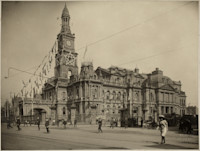
In 1865 the Council once again applied for a grant of a portion of the Old Burial Ground. This time the colonial government acquiesced. Part of the land that once formed the cemetery was formally transferred to the city council in 1869 for the construction of the Sydney Town Hall.

Plan from the Select Committee of the Legislative Assembly on St Andrews Cathedral Close Bill, 1867. (City of Sydney Archives) George Street runs along the bottom, Druitt Street to the right, Bathurst Street to the left. The blue area identifies the land transferred to St Andrews Cathedral. The large pink area (1 acre, 2 roods, 21 perches) identifies the initial amount of land transferred to the city council. The building outline for the town hall shows an early design proposal. This was not built. It was also proposed to extend Clarence Street south of Druitt Street, behind the town hall. This did not happen either. Notice the area projecting out into George Street (in front of the colour tint): this was also part of the original burial ground but was subsumed under a realignment of the street.
The Act of Parliament which authorised the land transfer (32 Vic. No.4, 1869) required the council to spend at least £25,000 on its building, which had to be completed by 1 January 1872. The grounds were to be laid out according to the recommendations of the Director of the Botanic Gardens, the enclosing walls had to satisfy the Colonial Architect, and any remains of corpses located had to be removed and re-interred as directed by the Minister for Lands. Failure to meet any of the standards or deadlines set out in the Act incurred severe financial penalties.
Robert Stewart, MLA, an established undertaker in nearby Bathurst Street, was given the difficult task of exhuming the remains from the old burial ground. Few could remember who was buried there - or where. It appears no plans or registers of the cemetery were kept and few headstones remained to guide the undertaker. Little is known about the actual exhumation process; there is no formal report recorded in the Council Minutes or surviving in the council archives. Research to date suggests that exhumations began in April 1869 and were completed by September. One report in “The Empire” (25 June 1869) stated that small test pits were sunk into different parts of the ground to ascertain the extent and state of preservation of remains. These excavations found little remaining in graves, but some coffins and skeletal remains in brick vaults. Headstone fragments were apparently ignored.
The remains which could be found were removed to a set of graves specially set apart in the Church of England cemetery at the new Necropolis, Haslem’s Creek (a.k.a. Rookwood Necropolis). Only one legible headstone remained standing, commemorating Captain Hamilton, and this was removed by relatives to the Necropolis as well. As a mark of respect, Council commissioned stonemason Francis Murphy to create a large classical monument to identify the graves at Rookwood. The inscription records the name of the Mayor but due to gaps in the historical record does not list any names of those buried in the old cemetery.

Erected
by the
Municipal Council
of the
City of Sydney
over the remains removed
from
St Andrew's
Cathedral Close
George & Druitt Streets
Sydney
Used as a cemetery
prior to the year
1822.
Walter Renny
Mayor.
Archaeological discoveries
The basic manner in which the exhumation was done was soon apparent. Stewart, the undertaker, appears to have followed the City Engineer’s advice to only clear the building’s footprint. The Deanery of St Andrew’s was built on part of the Old Sydney Burial Ground and coffins were unearthed during its construction in 1871-2. Coffins and a headstone to Darby Carbery were uncovered in 1888 when the main hall of the Sydney Town Hall was being completed, and in the 1890s water main excavations uncovered skulls.
The pattern of discoveries continued in the 20th century. In 1904 and 1924 when electric light cables were being laid, coffins and tombs were discovered.

Newspaper headlines proclaiming the coffin discoveries in July 1924. (City of Sydney Archives)
Tombstones and ironbark coffins were found by workmen in 1929 during the open-cut excavations for Town Hall Station. In 1974 vaults were uncovered during the excavation and formation of Sydney Square.
Drainage works under the Town Hall in 1991 brought to light another 7 graves, some with skeletal remains. Part of a headstone inscribed to Elizabeth Steel was also recovered.

A brick vault enclosing the remains of a wooden coffin discovered in 1991. (photo: City of Sydney Archives) The coffin was made of Australian red cedar, and fastened with iron nails and brass tacks. After the archaeological examination, The grave was filled in with sand and the bricks rebuilt across the top of the vault.
More recently in 2003, graves were discovered to the north of the Town Hall during building works for a new forecourt area.
And then in September 2007, with new building works about to commence, evidence of grave sites were again uncovered beneath the Lower Town Hall (Peace Hall). Initial site-specific archaeological investigations point to the remnants of at least 50 simple graves; no headstone fragments, coffin fragments or brick vaults have been uncovered. A report was prepared for the NSW Heritage Council before any further work was undertaken. The NSW Heritage Council has approved a permit to allow the removal of the remains.

Evidence of graves beneath the Lower Town Hall (Peace Hall) being documented during the archaeological excavation in January 2008. (photo: City of Sydney)
The archaeological work is being undertaken for the City of Sydney by Casey & Lowe Pty Ltd, who have extensive experience in this field. The current archaeological excavation commenced on 7 January 2008.
These archaeological discoveries help to build up a picture of the burial customs practised at the start of settlement. Contrary to expectations, it seems a number of the graves were marked by stone memorials. Furthermore, a large proportion of burials appear to have occurred in timber coffins rather than simple shrouds; again this is contrary to expectations of common burial practices in the fledgling colony. Evidence of brick-lined vaults and cedar coffins with brass studs confirm that elaborate funerary practices were current in the new colony, suggesting that British burial practices and customs were rapidly transmitted and adopted in Australia.
Archaeological and historical research into the Old Sydney Burial Ground is ongoing. New insights from the archaeological investigations and reports will be incorporated into this published history once the evidence has been recorded, reviewed and analysed.
Find out more
* A few larger maps and pictures of the Old Sydney Burial Ground can be viewed in the online exhibition about the building of Sydney Town Hall.
* Was your ancestor buried in the cemetery? An inventory of burials has been compiled from historical documents. This is the first time that a consolidated list of burials for the Old Sydney Burial Ground has been produced. The inventory can be viewed and downloaded from the City's website.
* Photos of the current archaeological works and a summary of the public open day are available on the City's website.
* The best published histories about the Old Sydney Burial Ground are:
- Birmingham, Judy & Carol Liston, Old Sydney Burial Ground 1974: emergency excavation in the City of Sydney, Studies in Historical Archaeology No. 5, Sydney, 1976.
A short but excellent history of the Old Sydney Burial Ground (Town Hall site) and description of archaeological finds uncovered in 1974.
- Johnson, Keith A & Malcolm R. Sainty, Sydney Burial Ground 1819-1901 (Elizabeth and Devonshire Streets) and History of Sydney’s Early Cemeteries from 1788, Library of Australian History, Sydney, 2001.
Includes an introductory chapter on the history of Sydney’s early burial grounds and particularly the Old Sydney Burial Ground and the Devonshire Street Cemetery. Majority of the book is indexes to trace removals from the Devonshire Street Cemetery.
Bibliography
This short history was researched and written by City of Sydney historian Dr Lisa Murray and draws upon the following source material.
- Birmingham, Judy and Carol Liston, “Old Sydney Burial Ground 1974”, Studies in Historical Archaeology No. 5, Sydney, 1976.
- New South Wales Legislative Council Votes & Proceedings, “Report from the Select Committee on the General Cemetery Bill”, 1845.
- New South Wales Legislative Assembly Votes & Proceedings, “Burial Grounds Sydney (and proposed general cemetery)”, 1863.
- New South Wales Legislative Assembly Votes & Proceedings, “Report from the Select Committee on St Andrew’s Cathedral Close Bill”, 1867.
- Johnson, Keith A., ‘Sydney’s Early Burial Grounds – Part 2 – The Old Burying Ground, George Street, 1792-1869’, “Descent”, vol. 5 no.1, 1970, pp.26-43.
- Johnson, Keith A & Malcolm R. Sainty, “Sydney Burial Ground 1819-1901 (Elizabeth and Devonshire Streets) and History of Sydney’s Early Cemeteries from 1788”, Library of Australian History, Sydney, 2001.
- Lowe, Anthony and Richard Mackay, ‘Old Sydney Burial Ground’, “Australasian Historical Archaeology” [journal], vol. 10, 1992, pp.15-23.
- Murray, Lisa, "Cemeteries in Nineteenth-Century New South Wales: Landscapes of Memory and Identity", PhD Thesis, Department of History, University of Sydney, 2001.
- Old Chum, ‘Old Sydney No.156’, “Truth”, 9 October 1910.
- ‘Peeps at the Past – “Secrets of the Tomb” The Old George-Street Burial Ground’, “The Sun”, 10 October 1911.