City of Sydney

| Skip to Content | Skip to Menu | Contact Us  |   About Us  |   Media Releases

Sydney Town Hall - The Grand Organ

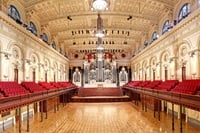
The Grand Organ, Sydney Town Hall

Built in London by William Hill and Son, the Grand Organ was shipped to Australia and installed in 1890. It was then the largest organ in the world and is still the largest ever built with tubular-pneumatic action. Its 126 speaking stops and 14 couplers are spread over five manuals (Choir, Great, Swell, Solo, Echo) and pedals. There are approximately 8,700 pipes.

The first recital was held on Saturday 9 August, 1890 at which the City Organist from Liverpool, England W.T. Best performed for 4,000 guests.

The organ was restored between 1972 and 1982 by Sydney organbuilder Roger H. Pogson and is used regularly for performances, including many played by the City Organist, Robert Ampt.

The Grand Organ – A Remarkable History

During the second half of the nineteenth century it was customary for the civic halls of England and her colonies to be provided with organs of imposing dimensions; dimensions which in themselves spoke of a city’s pride and aspirations. With Sydney’s own Town Hall itself a structure of lavish proportions, it is no surprise that the original designers of the organ conceived an instrument on the grandest possible scale.

As early as 1879, when plans were first being drawn up for the hall, an organ scheme from Messrs. William Hill and Son of London was already under consideration. This scheme provided for an instrument of 59 speaking stops, and was to cost 5,000 pounds, "packed in zinc lined cases and delivered at the docks". The proposal, although creating interest, provoked no immediate action, perhaps because it was considered too modest for the "London of the South Seas".

Piano in front of the Grand Organ

Drawing up a specification for the proposed organ proved a mammoth undertaking, and for this task an Organ Committee of Sydney organist and organbuilders was formed. The consequent recommendation was for an instrument of unprecedented proportions with five manuals and pedals, and nearly 150 stops and couplers - the largest organ in the world at the time. The Organ Committee also suggested that only two English organ builders - William Hill and Son and Henry Willis and Son - be invited to tender, although the City Council decided to call for tenders on a completely open and unrestricted basis.

Back to top

In the final selection, the choice was narrowed down to two English builders - William Hill and Son, and Gray and Davison. Adopting a comprehensive system of calculation involving freight charges, insurance and interest payments, the final cost of erecting and then maintaining the organ for twelve months was, in the case of Hill’s tender, estimated to be 14,241 pounds, just 1,266 pounds higher than the all inclusive Gray and Davison tender. Yet the Organ Committee argued that because of certain costly modifications suggested by Hill (for example the inclusion for the first time ever a full-length 64 foot pedal stop), the real difference was only 716 pounds. The Organ Committee favoured Hill, and it was the Hill tender which the Council accepted.

When the organ was finally completed in Hill’s London workshop, and before it was dismantled for shipping to Australia, prominent English organists were invited to test it. The famous Mr W.T. Best (who subsequently opened the organ) found it, "...a marvel of excellence in both tone and mechanism". Similarly, Mr Hoyte enthusiastically pronounced it, "...the very finest organ in every respect I have ever played upon", while the organist of Westminster Abbey, the redoubtable Dr Bridge, simply considered it, "...the finest organ ever built by an English organ builder"; sentiments which must have inspired eager impatience on the other side of the globe in Sydney.

Grand Organ Pipes

At the time of submitting his tender, Hill had, at no extra charge, also submitted a drawing for an organ case. However, the City Architect, who was responsible for the design of the hall fittings including the organ case, felt that the essentially historical design put forward by Hill clashed with the modern character of the hall, and so he suggested "some trifling alterations". But when this altered version was sent to Hill for comment, a disappointed and angry response was immediately forthcoming. Hill wrote, "We observe, however, with regret, that the (case) design submitted to us for estimate is entirely different from that prepared by us with so much care." The revised design swept away the pipe shades, the canopied turrets at the top of the case, and the characteristic V-shaped towers which were intended to impart a sense of scale to the large 32 foot pipes in the case centre. Hill’s design was based on the c. 1660 organ case in the Church of St. James, Stralsund, and so the modern details of the City Architect’s revised plan were considered out of character with the historically inspired original.

Back to top

The Organ Committee sided with the organ builder, and in a stirring letter to the City Council wrote:

"With regard to the choice of a design ... the theory that the architecture of an organ should always closely correspond to that of the building in which it stands, is fairly balanced by another view, viz. that the King of Instruments (and we think that if any organ merits that appellation, it may well be attached to an organ so large and magnificent as that we look forward to possess for the City of Sydney) is entitled to its own characteristic garb ... thereby gaining in individuality and power of contrast with the surrounding hall - a contrast by which the latter need not lose, but may very largely gain."

Almost immediately the Hill design was accepted, with the result that the Sydney Town Hall came to possess an organ case which, in splendour and beauty, can be compared with the greatest organs of the world.

The opening of the Grand Organ took place on Saturday 9 August, 1890. For this occasion, and at considerable expense, the City Council engaged the services of the one considered by many to be the finest concert organist in the world - Mr W.T. Best, the City Organist of Liverpool, England. For this concert the hall was packed with 4,000 invited guests; members of parliament, judges and lawyers, the admiral’s suite, aldermen, church leaders, and many other prominent citizens. But in the bustling post gold-rush days of Sydney, with bush ranger Ned Kelly dead barely ten years, not all of these audience members were able to boast a rich and cultivated understanding. It was reported that some of them kept up a discourse throughout much of the concert, while at times random whistling was even heard. Still, the concert was a resounding success.

Best gave eleven more recitals and to these the general public was admitted, paying Six Pence and One Shilling for tickets. These concerts were a brilliant success, with The Sydney Morning Herald calling them, "...the special attraction of the city right now’. The City Council was also happy, for already after the fifth concert it had recovered all of Best’s fees and expenses.

Best drew his music exclusively from the "classical" repertoire, with about half of the pieces being arrangements, usually from operas. Bach organ works appeared in five of the programs (the opening concert began with the 'Toccata and Fugue in D minor'), while in all but one, the organist performed works from his own pen.

Back to top

After Best’s recitals it was automatically assumed that a City Organist would be appointed. The first Sydney City Organist was Auguste Wiegand, a Belgian who held the post from 1891 until 1900. He was followed by the Australian organists Arthur Mason (1901 - 1907), Ernest Truman (1909 - 1935), and Robert Ampt (appointed 1978).

But what of the organ itself? When it was opened in 1890, not only was it the largest organ in the world, the King of instruments, but it was also heralded as one of the technical and musical triumphs of the time. Its splendid tone thrilled tens of thousands of music lovers while its mechanism left organists completely satisfied. Yet during the 1950s and 1960s, criticism of the organ’s tone and mechanism became increasingly sharp and public. A press criticism from 1964 spoke of, "windy pipes, noisy action, and a curious lack-lustre tone", while a report which appeared in the Sydney Morning Herald in 1969 could not have been more scathing. "Despite occasional statements to the contrary, the Town Hall organ is not a cause for civic pride..." Elsewhere the Grand Organ was referred to as, "a monstrous bag of wind", and the famous 64 feet stop as "hardly musical, but ... probably apocryphal".

What was suddenly wrong? There were, in fact, two problems. In the first place, the tone of the organ had become old fashioned, for by the 1960s the first tremors of the Organ Reform Movement had reached Australia. This new movement or organ building style revolved exclusively around the neo-baroque organ with its bright, crisp tone and mechanical action, and it called for the destruction of all heavy toned nineteenth century instruments. The Town Hall organ became the primary target. Almost overnight Sydney ceased to possess the finest and grandest concert organ in the world, and instead, as some thought, became the unfortunate custodian of one of the ugliest and most gluttonous Victorian monstrosities ever created.

The second problem was with the organ itself: its mechanism was tired and worn, its wind system faulty, and many of its pipes partially clogged with dirt. The organ was simply not functioning properly and this fact detracted immensely from its musical capabilities. Finally in October 1971 the organ broke down completely, causing the cancellation of performances. At the same time the Council’s organ contractor, organ builder Sidney Noad, suffered a heart attack and had to resign after a remarkable 45 years. Another Sydney organ builder, Roger Pogson, was then immediately contracted to maintain the organ.

In mid-1972 Pogson submitted a report on the condition of the instrument, and at the same time the City Council called for an estimate of costs necessary "to restore the Grand Organ, as near as practicable, to its original state". Then at its meeting of 8 November, 1973, the Council finally made the historic decision to restore the magnificent organ. The decision was, in some respects, quite undramatic, for all it amounted to was the allocation of sufficient funds to completely repair and restore those portions of the instrument most urgently in need of repair, although funds eventually extended this work to include every facet of the instrument. The organ builder was free to choose the order in which he undertook his work, and was given both the authority and the encouragement to carry out this work as thoroughly and as exactly as possible. The result was a slow but steady restoration of the pipes, mechanism, action and console which saw the condition of the organ continually improve. Throughout the entire restoration program, the organ was unavailable only during 1981 and 1982 when the huge five-manual console was removed. All work was entrusted to the Pogson firm.

Ornamental Angel on the Grand Organ

The Organ was reopened again on 11 December, 1982 by Robert Ampt with the A.B.C. Sinfonia conducted by Helen Quach.

The final stage of the organ’s restoration unfolded in 1992 when the Town Hall was restored. At this time the original colour scheme for the case, with its lavish gilding, was reinstated. The hall restoration also saw the removal of the acoustic tiles installed in 1964 at the request of the Australian Broadcasting Commission, so that an acoustical environment close to that for which the organ was originally designed was again recreated.

Today the Grand Organ is in excellent condition and is maintained by Sydney organ builder Manuel da Costa, who had worked with Pogson on the restoration. The instrument is of international significance and is generally considered to be the finest nineteenth century Romantic concert organ in the world.

Back to top

Please Note:
While care is taken to ensure accuracy, the City of Sydney cannot guarantee that information expressed here is correct and recommends that users exercise their own skill and care with respect to its use. The City of Sydney makes no warranty or undertaking, whether expressed or implied, nor does it assume any legal liability, whether direct or indirect.