City of Sydney

| Skip to Content | Skip to Menu | Careers  | Contact Us  |   About Us  |   Media Releases

2. What is Homelessness?

Homelessness Information Kit for Volunteers


‘Homelessness’ is much more than ‘houselessness’

Homelessness can mean a number of things. At its most basic definition, it can simply mean being without any shelter. However, most of us don’t just think of our home as merely a place of shelter. Usually, a ‘home’ is not just a house, it represents family and friendships and social connections with other human beings.

Most people’s experience of homelessness is brief

In the majority of instances ‘homelessness’ will be a brief incident that any of us can experience during our lifetimes.  There are many reasons why any one person could experience homelessness including:

  • Moving to another city or town and staying with a friend until a suitable home is found.
  • Leaving a family home because of conflict, domestic violence or family breakdown.
  • Loss of employment or a gambling addiction can mean people are evicted for non-payment of rent.

In the vast majority of these cases, people can get their lives back together again, find new work, deal with their addictions, with or without the help of community services and find suitable housing and continue on with their lives.

Some people may experience longer episodes of homelessness

In some instances, the experience of homelessness can be traumatic and longer term.  Some people, usually those without family or social support, may find themselves stuck in homelessness. Some may become ‘rough sleepers’, others may cycle through a range of inadequate and short term accommodation arrangements. They may stay in squats, private rooming houses or on friend’s and relatives couches.

Some may access homelessness hostels, intoxicated persons units (IPU) or other services established to assist people in need of crisis accommodation.

Back to top

A definition of homelessness

A common definition of homelessness, developed by two Australian researchers, Chamberlain and Mackenzie (1992) categorises homelessness into three broad areas. These are:

  • Primary homelessness: People without conventional accommodation, such as rough sleepers, squatters etc.
  • Secondary homelessness: People who frequently move between temporary accommodation, emergency shelters sleeping on couches etc.
  • Tertiary homelessness: People who have insecure tenure and who may be staying long term in boarding houses where they do not have private bathroom or kitchen facilities.

Workers and volunteers who provide crisis services to homeless people (eg. overnight shelters; free food services) are most likely to have contact with people experiencing ‘primary homelessness’. However, they will also sometimes be in touch with those experiencing secondary and tertiary homelessness.

Some people, who may actually be in secure housing, but who experience disadvantage because they may have no or little income may also use free or subsidised food or other social services.

Also, some people who may have previously experienced chronic homelessness but who have since found accommodation have often developed solid friendships and social networks with people who are still homeless. They may meet up with these people on the streets, some may drink together and also use some homelessness services, such as day centres and food services.

Another definition of homelessness – by people who experience it

The Chamberlain and Mackenzie definition is sometimes criticised because it defines homelessness in relation to people’s access to shelter or housing. Alternative definitions of homelessness have been developed. The following definition is used along with the Chamberlain and Mackenzie definition in the City of Sydney’s Homelessness Strategy 2007-2012. It was based on work done by Kraybill and was developed in conjunction with some people who are currently experiencing long term homelessness.

The First Home: the self. The characteristics of this home are physical, mental, emotional, social and spiritual in nature.  This home needs to be nurtured, rested, nourished and emotionally supported.

The second home: might cover any of the descriptions provided under the primary, secondary and tertiary definitions of homelessness. It is the place where we live, and it refers not only to the physical structure but to the living environment within which it is located.  This home is where we sleep, where we begin and end every day, where we store our belongings, it may be where we socialise and interact with others.

The third home: is the larger community within which our first and second homes are located.  It provides context to the lives that are lived within it and how that is realised at an individual level.  Here the connectivity between individuals, multiple communities, the residential, business and visitors all meet in the same place.  The quality of that home is defined by the relationships of all groups within it.

Being homeless

One of the people consulted by the City of Sydney during the development of its Homelessness Strategy 2007 – 2012 stated the following:

“Over the years I have met and got to know so many decent homeless people.  Homelessness is the result of a set of circumstances that get out of control and no two are exactly alike and when you arrive, all illusion is swept away, your very humanity your morality, your sense of right and wrong and you ask yourself why do people look at me like that?  I believe that the battle against homelessness must start with changing society’s perception.  The round peg in the round hole is a sound idea, but when you put a square peg in a round hole, that’s when things start falling apart…”

Back to top

Key points

  • Homelessness is not just about a lack of shelter.
  • We might all experience an episode of homelessness in our lives. For most of us this will be a brief experience.
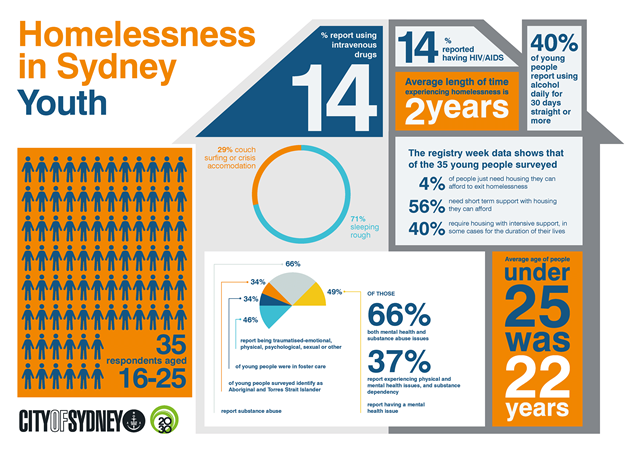
  • Some people who experience long term homelessness may have drug or alcohol addictions, mental illness, health problems, disability, a background of trauma and/or limited or no family support.
  • A common definition of homelessness identifies 3 categories; Primary; Secondary and Tertiary.
  • There are other definitions of homelessness, which refer to people’s lived experience and not just their access to housing or shelter.
  • Some people who were long term homeless but are now housed may retain their friendships and social networks with people who are still homeless.


<< Previous | Module 1 | Next >>

Back to top

Please Note:
While care is taken to ensure accuracy, the City of Sydney cannot guarantee that information expressed here is correct and recommends that users exercise their own skill and care with respect to its use. The City of Sydney makes no warranty or undertaking, whether expressed or implied, nor does it assume any legal liability, whether direct or indirect.