|


| |
 |
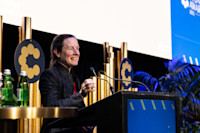
| Jonathon
Bottrell, curator of Boomalli Aboriginal Artists Cooperative,
talks about the history and philosophy of the coop. |
| |
 |
| Jonathon
Bottrell, curator of Boomalli Aboriginal Artists Cooperative,
talks about the role of Boomalli in maintaining Aboriginal history
and culture in Sydney. |
| |
 |
| Phillipa
McDermott from Gadigal Information Service talks about
the importance of Koori Radio in catering for and representing the
interests of Koori people in Sydney. |
|
 |
| |
|
|
The AUSTRALIAN ABORIGINES PROGRESSIVE ASSOCIATION
(APA), led by Fred Maynard, operated in Sydney from 1924 to 1927
when it was disbanded due to police harassment. In 1932 in Victoria,
William Cooper, Bill Onus and Ebenezer Lovett formed the Australian
Aborigines Advancement League which sent a petition to King George
V calling for special electorates for Aborigines. Inspired by Cooper's
League, William Ferguson organised the inaugural meeting of the
New South Wales branch of the ABORIGINES PROGRESSIVE ASSOCIATION
in Sydney in 1937. The APA,
led by Ferguson and Jack Patten, planned the 1938 "Day of Mourning
Conference and Protest" in Sydney, where the Committee for Aboriginal
Citizenship Rights was formed. This operated until 1944. The three
aims of the APA were full citizenship rights for Aborigines, Aboriginal
representation in Parliament and the abolition of the NSW Aborigines
Protection Board. From March 1938, the Australian Abo Call: the
voice of the Aborigine was published as the official journal
of the APA.
|
 |
This
"Save our Site" poster by Brenda Palma is a collage of images
from the first issue of Abo Call, the ‘Day of Mourning’ site
at 150 Elizabeth Street, Sydney, and people present at the Aborigines
Progressive Association conference in 1938.
(© Brenda Palma, 1997) |
 |
 |
 |
|
The ABORIGINAL AUSTRALIAN FELLOWSHIP (AAF) functioned from 1956
to 1969, supported by a new generation of activists and supporters
such as Pearl Gibbs, Joyce Clague and Faith Bandler. It stood for
the principle that Aborigines in New South Wales deserved equality,
and fought to have Managers abolished from stations. In 1960, the
AAF called for full citizenship rights for Aborigines.
Growing out of the AAF, the FOUNDATION FOR
ABORIGINAL AFFAIRS was located in the old 2UW Theatre in George
Street and was commonly known as "the Foundation". It sought to
advance the Aboriginal cause by promoting cultural skills in music
and dance as well as by political means. It became a focus for Indigenous
social life, a modern day meeting place. The Foundation nurtured
many bands and artists including The Silver Lining, Black Lace,
Jimmy Little, Col Hardy, Candy Williams and Max Silva.
Activists such as Paul Coe and Gary Foley emerged
from the Foundation. The ‘Vote Yes’ campaign was launched in the
Hall of Foundation on Sunday 2 April 1957. In the same year, the
AAF organised a meeting at Sydney Town Hall to promote their campaign
for a referendum
to change the Australian Constitution to give the Federal Government
the power to legislate for Aboriginal people .
The FEDERAL COUNCIL FOR ABORIGINAL ADVANCEMENT was formed in 1958
for the same purpose. This was renamed the FEDERAL COUNCIL FOR THE
ADVANCEMENT OF ABORIGINES AND TORRES STRAIT ISLANDERS (FCAATSI)
in 1964. One of the prime movers in this was Jessie Street (1889-1970),
an influential non-Aboriginal social reformer. The organisation
was made up of trade unions, churches and "do-gooders" and it was
not until closer to the referendum that large numbers of Aboriginal
people became involved in the movement. The Communist Party was
the only Australian political party which didn’t include the White
Australia Policy as part of their platform and was regarded as a
supporter of FCAATSI.
Joe McGuiness, a
Sydney waterside worker, became the organisation’s first Aboriginal
President from 1961 to 1966. In the lead-up to the 1967 referendum,
FCAATSI pushed for equal pay for Aborigines and supported their
Gurindji brothers and sisters when, in August 1966, they sought
better pay by walking off Wave Hill Station in the Northern Territory
(where it was an offence to pay award wages to Aborigines).
FCAATSI worked for equal wages for equal work,
rights for Aborigines to own and manage their reserves and for an
end to social, economic and political discrimination. They also
sought international support for their land rights campaign. FCAATSI
opposed all forms of mining on Aboriginal land and considered the
principle of a republic for Australia.
Supported by people like Pat O'Shane, Marcia
Langton and Evelyn Scott and many well-known Aboriginal residents
of Sydney, FCAATSI also pushed for a policy of free but compulsory
education for detribalised people.
TRANBY ABORIGINAL COLLEGE
is owned and managed by Aborigines and is a community-based non-profit
organisation, providing an alternative independent learning environment
for Aboriginal and Torres Strait Islanders. Established in 1957
in the inner Sydney suburb of Glebe, Tranby's parent body is the
CO-OPERATIVE FOR ABORIGINES LTD (formerly the ABM Christian Community
Co-operative). The Cooperative was formed under the auspices of
an Anglican priest, Reverend Alf Clint, who had been working with
Indigenous communities in northern Australia since the early 1950s.
With the gift of the heritage property "Tranby" in 1957, the Co-operative
began to develop courses for adult Indigenous students. The Hon.
G.A. Kelly, Chief Secretary of NSW and the Minister of Co-operative
Societies, officially opened Tranby on February 23, 1959. In 1962
it became fully independent and remains so today. |
 |
 |
 |
 |
 |
Anglican clergyman, Rev
William Alfred (Alf) Clint (1906-1980), the founder of the Co-operative
for Aborigines and its famous offspring the Tranby Co-operative College.
He supported Aboriginal cultural self-determination and land rights
when these were not popular ideals among White Australians.
(© Co-operative for Aborigines Ltd.
If this image is reproduced in any other form, please acknowledge
the Tranby Aboriginal College Archives, 13 Mansfield St, Glebe, NSW,
2037) |
Tranby Co-operative Aboriginal
College in suburban Glebe in the 1960s. Tranby was initially regarded
with suspicion because it was supported by Trade Unions but it has
been pivotal in training Aboriginal people in self-determination.
(© Co-operative for Aborigines
Ltd.
If this image is reproduced in any other form, please acknowledge
the Tranby Aboriginal College Archives, 13 Mansfield St, Glebe, NSW,
2037) |
 |
| In
the early years of operation, particularly between 1961 and 1962,
many students were assisted by scholarships funded by unions, churches,
the Sydney City Council and the Federal Parliamentary Labor Party.
These enabled them to be trained in trades, office work, store management
and media.
Tranby was the focus for much political activity
leading up to the 1967 Referendum, including the Vote "Yes" Celebrations
on 9th June 1967, and the International Co-operative Day on 14th
August in the same year. In 1973 the College organised a seminar
to alert Federal and State Members of Parliament to the need for
Indigenous input into their work.
In 1981 Kevin Cook became the first Aboriginal
General Secretary of Tranby, followed by Jack Beetson as Executive
Director in 1998. The Co-operative developed affiliate organisations
such as Blackbooks (formerly the Centre for Black Books, 1982),
the Aboriginal Development Unit (1986) and the Aboriginal Homeless
Persons Hostel (1982), while continuing to be pro-active in the
Land Rights Movement and the push towards the Royal Commission into
Aboriginal Deaths in Custody. Tranby now runs a Diploma of National
Indigenous Legal Studies, an Advanced Diploma of Applied Aboriginal
Studies (for both Aboriginal and non-Aboriginal people) and the
Diploma of Development Studies - Aboriginal Communities, and all
courses are accredited by the NSW Vocation, Education and Training
Accreditation Board. The first students at Tranby were residential,
but block release (short intensive revision courses) is now the
common format for correspondence students who live outside Sydney.
In 1998, the College was reconfigured and the buildings now reflect
the philosophy of the Aboriginal "learning circle" with round rooms
surrounding an amphitheatre/courtyard.
The METROPOLITAN LOCAL ABORIGINAL LAND COUNCIL
is currently situated at Australian Hall, 150-152 Elizabeth Street
in Sydney, the heritage-listed site of the 1938 Day of Mourning
Conference. In 1973, the Council was established at the Black Theatre,
in the suburb of Waterloo. Founding members included Allen Madden,
Jenny Munro and Sol Bellear. After conservation, the Australian
Hall will house the Metropolitan Local Aboriginal Land Council,
the National Aboriginal History and Heritage Council, a barrister's
chamber, museum and a nightclub owned by the Redfern All Blacks
Football Team.
Originally established as the Aboriginal and
Islander Skills Development Association (AISDS) in 1975, the NATIONAL
ABORIGINAL AND ISLANDER SKILLS DEVELOPMENT (NAISDA) grew from the
visions of several young Sydney-based Aboriginal people for a centre
where Indigenous people could develop and express themselves through
dance. Today, NAISDA claims a number of 'firsts' in performing arts
and education. The Association was the first tertiary dance institution
established in NSW; the first performing arts and training institution
catering to Aboriginal and Torres Strait Islander people; and the
first Aboriginal and Torres Strait Islander organisation to be granted
Diploma status accreditation in dance and related performing arts
skills.
|
In 1977, the NSW ABORIGINAL Education Consultative
Group (AECG) was formed and for some time was based in the city in
Young Street. Now in the suburb of Stanmore, the AECG is a community-based
organisation designed to promote discussion amongst the diverse Aboriginal
communities involved in developing Aboriginal education policy in
NSW. The AECG focuses on empowerment and self-determination with equity,
cultural integrity and the community base fundamental to their beliefs
and practices. The organisation advises the NSW Minister for Education
and Youth Affairs as well as other key government departments and
the NSW Teachers Federation. |
|
The JUMBANNA CENTRE is located at the University of Technology,
Sydney (UTS). Established by two former Aboriginal students, it
is a meeting place for students and staff and provides specialist
advice and services including a resource library, computer facilities,
and tutorial assistance and counselling. Such support assists Indigenous
students to participate in a variety of higher education courses.
Like the Jumbanna Centre at UTS, the KOORI CENTRE
at the University of Sydney provides programs, services and facilities
to encourage and support Aboriginal and Torres Strait Islander students
at the university. The Koori Centre facilitates the teaching of
Aboriginal studies and supports research in the field of Aboriginal
education.
The Centre also maintains close links with Yooroang Garang, the
Aboriginal Education Unit in the Faculty of Health Sciences on the
University's Cumberland campus.
Established in June 1982, BLACKBOOKS
is an initiative of Tranby Aboriginal College and is located in
the College complex in Mansfield Street, Glebe. At present, it is
the only distributor and retail outlet owned and controlled by Aboriginal
people. Blackbooks carries an extensive range of resources including
books, tapes and CDs, flags, posters and arts and crafts. Their
annual catalogue lists books specifically by Aboriginal authors.
The COMMITTEE TO DEFEND BLACK RIGHTS was established
in Sydney in 1984 by concerned Aboriginal people and their supporters
in response to the events surrounding the death in prison of 16-year-old
John Pat from Roebourne in Western Australia. The Committee has
maintained an ongoing campaign against black deaths in custody with
public forums, rallies, pickets and newsletters. In 1986 the Committee
held film nights at Tranby Aboriginal Cooperative College and covered
a wide range of Aboriginal issues, acting as a way of educating
the general public. The Black Deaths in Custody Watch Committee
met at Trades Hall in Goulburn Street for many years and in 2000
moved to Parramatta.
BOOMALLI ABORIGINAL ARTISTS COOPERATIVE was
formed in 1987 by a group of artists based in Sydney. Boomalli,
meaning "to strike, to make a mark", is a language word from at
least three nations - Bundjalung, Gamileroi and Wiradjuri. Exhibitions
held by the members of the organisation have left their artistic,
cultural and political marks on the city of Sydney and all those
who have experienced them. |
| Boomalli
provides a community art gallery for the display of Aboriginal works
of art and promotes Aboriginal culture and independence through
the visual arts and film. They devote much space to contemporary
and urban artworks and the organisation continues to act as an advisory
and referral service, facilitating residencies (locally, nationally
and internationally) and assisting members to enter exhibitions
outside Boomalli. The Cooperative has relocated a number of times,
but always maintained its presence within the city of Sydney, while
remaining accessible to its Aboriginal community.
The BUILDING BRIDGES ASSOCIATION was established in 1988 when
it brought together some of Australian's finest musicians - black
and white - to promote Aboriginal musicians and to create a forum
to highlight Aboriginal issues. This musical movement aimed at building
bridges of understanding and respect, while fighting racism, prejudice
and ignorance and instilling the belief that Aboriginal and non-Aboriginal
people could live together in harmony.
The Association was a collection of
organisations active in the Aboriginal movement generally and included
Tranby Aboriginal College (Kevin Cook as Secretary), the National
Unions Coalition, Young Labor, the NSW Aboriginal Land Council,
the Australian National Women's Rock Institute, 2JJJ and 2MMM.
The main function of the Association was to
organise a series of concerts (often with a large non-Indigenous
audience) and the "Building Bridges" concert at Bondi Pavilion on
24 January 1988 was the first. It featured musicians such as Yothu
Yindi, Midnight Oil, Scrap Metal, Crowded House, Coloured Stone,
Mixed Relations, Kev Carmody, Archie Roach, Toni Janke, the band
Weddings, Parties, Anything and guest speaker Gary Foley. "Rock
for Land Rights" concerts followed in 1990.
A Building Bridges album was 47 'with a bullet'
in the national charts in March 1989. In 1990 the Association received
a Certificate of Commendation in the Human Rights Awards.
|
 |
 |
Bangarra
Dance Theatre performing at the Black Vine Concert, Sydney Town Hall,
13 July 1995. (City of Sydney
Archives. NSCA CRS 904/1474 - neg.28) |
 |
. |
| In 1989 BANGARRA DANCE THEATRE AUSTRALIA
Ltd was formed in Sydney and has trained at the Walsh Bay wharf
complex near Sydney Harbour Bridge since 1997. The company uses
dance, music and song to entertain and educate audiences all round
the world. Bangarra has received national and international recognition
for their contemporary style of performance using traditional forms
of dance from remote areas like Yirrkala in Arnhem Land in northern
Australia.
Established in 1990, SYDNEY ABORIGINAL DISCOVERIES
is a tourist attraction that is operated by Sydney-based Aboriginal
entrepreneurs, Margret Campbell and Dallas Dodd. It includes a tour
called "Cadi Warrane" (Sydney's Gathering Place) beginning with
a walk along the uncharted cultural map of Cadigal
country, teaching about the saltwater lifestyle and songline concept.
There is also an explanation of the Aboriginal Creation of particular
features in the area, and a look at native coastal vegetation, including,
of course, a taste of local "bush tucker".
 |
Aboriginal
guides, Margret Campbell and Dallas Dodd, of Sydney Aboriginal
Discoveries, invite visitors to explore Sydney’s Aboriginal
past and present. (Sydney
Aboriginal Discoveries at abtours@abtrade.com.au)
|
 |
 |
 |
Sydney-based NATIONAL INDIGENOUS ARTS ADVOCACY
ASSOCIATION (NIAAA) is a national cultural service and advocacy
association working for ongoing and increased recognition and protection
of the rights of Indigenous artists. NIAAA also provides culturally
appropriate advice, information, referrals and support services
to Indigenous artists and organisations.
NIAAA produces resources advising on computer-generated
artwork and copyright, reproduction of artwork, Indigenous dances
and issues of cultural and intellectual property. The organisation
is concerned about the number of non-Indigenous artists, writers,
and performers that have been incorporating Indigenous Australian
cultural expression into their works. In 1999 they released the
"Label of Authenticity" to assist in the protection of Aboriginal
cultural and intellectual property.
ABORIGINAL NATIONS is an animation studio in
Chippendale on the fringe of the CBD. Its core activity is to produce
works of cultural significance via the medium of animated film.
The organisation has trained over 40 Aboriginal and Torres Strait
Islander artists in the techniques of traditional and computer assisted
animation, many working on a 13 episode series called "The Dreaming".
GADIGAL INFORMATION SERVICES (GIS) moved from
Cleveland St Chippendale to the old Marrickville Hospital in 1999.
It is a community-based media / arts and information service incorporated
in July 1994 as a reaction to years of mainstream media portraying
Indigenous Australia through negative stereotypes. GIS is the home
of KOORI RADIO which grew out of Radio Redfern, with air-time on
Radio Skid Row. Kori Radio has diverse programming that takes in
other marginalised Indigenous groups in Sydney such as Torres Strait
Islanders, Pacific Islanders and the East Timorese. The organisation
supports all art forms including visual arts, theatre, music, multi-media
and literature.
 |
 |
(© Gadigal Information Services
Aboriginal Corporation.) |
 |
. |
Initially called the Aboriginal History Committee, the NATIONAL
ABORIGINAL HISTORY AND HERITAGE COUNCIL (NAHHC) was established
in Sydney in July 1996. It is an incorporated voluntary organisation
working for the recognition and preservation of Indigenous heritage.
The organisation grew primarily out
of the campaign to save Australian Hall, the 1938 "Day of Mourning
and Protest" site at 150-152 Elizabeth Street, Sydney. After a hard
six-year struggle, the site is now a Heritage-listed building and
was purchased through the Commonwealth Indigenous Land Fund and
placed in a Trust to the Sydney Metropolitan Aboriginal Association,
managed by the Metropolitan Local Aboriginal Land Council.
NAHHC has a wide-ranging
charter offering support for the development of research and cultural
projects, with volunteers running an information and resources centre
dealing with all aspects of Aboriginal history and heritage. The
NAHHC continues to campaign for the protection of Aboriginal sites
and places considered "at risk", and has representatives on the
National Parks and Wildlife Service Heritage Committee and the History
Council of New South Wales, the peak history body in the State.
Dillon Kombumerri, Kevin O'Brien and Alison Page are all Indigenous
designers who make up the MERRIMA ABORIGINAL DESIGN UNIT within
the NSW Department of Public Works and Services. The unit provides
consultation and culturally-sensitive design services for Indigenous
communities, and the group’s designs reflect cultural information
endorsed by community elders. As well as working on community projects
like the NAISDA Dance Studio at The Rocks, they have also undertaken
projects with funding from several NSW government agencies including
the Ministry of the Arts, Department of Health, Corrective Services
and Juvenile Justice. Merrima’s most recent project is the Bayagul
Indigenous Gallery at the Powerhouse Museum.

Redfern, sitting on the fringes of the City of
Sydney, is the oldest surviving urban Aboriginal community in Australia.
Within this small inner suburb there are a number of Aboriginal
organisations that complement and supplement the work of organisations
in the heart of the city. These organisations include the first
Aboriginal Medical, Legal, Housing, and Child Care Services, as
well as the home of the Black Theatre Company and the Eora Centre.
|
|
|