|

 |
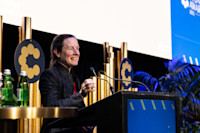
| Brenda
Palma, from the National Aboriginal History & Heritage
Council, tells us why the 1938 Day of Mourning was so important in
Sydney's Indigenous history. |


| |
 |
| Evelyn
Scott, Chairperson of the Council for Aboriginal Reconciliation,
welcomes people to Corroborree 2000. |
| |
 |
| Geoff
Clark, Chairman of ATSIC, addresses the audience at Corroboree
2000. |
|
 |
| |
|
| January 26 was nominated as Australia Day
to celebrate the anniversary of white settlement. It commemorates
the ceremonious unfurling of the British flag at the head of Sydney
Cove by Governor Arthur Phillip in 1788. By the beginning of the
21st century, however, it is also recognised as a day of mourning
for the invasion and dispossession of Australia's Aboriginal people.
To many people, both Aboriginal and non-Aboriginal,
the day will never be seen as a national day of celebration. The
landing at Sydney Cove marks the beginning of bitter wars, unnecessary
and brutal deaths, and the continuing struggle for survival by Aboriginal
people in Sydney and around Australia.
The Centenary in 1888 was
a proud celebration of British and Australian achievement. Aboriginal
people boycotted the celebratory events but their absence went unnoticed
by mainstream Australians. By 1938 though, Aboriginal people in
Sydney were becoming more organised in their political activities.
Bill Ferguson organised the first meeting of the Aborigines
Progressive Association in 1937 in preparation for an event
to mark the 150th anniversary of the British arrival. Ferguson,
William Cooper (leader of Victoria's Australian Aboriginal League)
and Margaret Tucker organised "A Day of Mourning and Protest" and
a conference for January 26, 1938. This event was held in the Australian
Hall at 150 Elizabeth Street after they were refused use of Sydney
Town Hall. The meeting was the first Aboriginal civil rights gathering
and was a major step towards redressing the wrongs of history against
Aboriginal people. Leaflets advised that "Aborigines and persons of Aboriginal blood only are invited to attend" the Day of Mourning and Protest Conference at Australian Hall on 26 January 1938. It attracted some 1000 Aboriginal men and women
and was the culmination of ten years of action by Aboriginal people
against the policies of the NSW Aborigines Protection Board.
|
 |
 |
Jack
Patten reads the resolution at the Day of Mourning Conference on 26
January 1938: "We, representing the Aborigines of Australia…on the
150th Anniversary of the whitemen’s seizure of our country, hereby
make protest against the callous treatment of our people…and we appeal
to the Australian nation of today…for full citizen status and equality
within the community."
Man, March 1938.
Mitchell Library, State Library of New South Wales |
 |
 |
The "Day of Mourning and Protest" made an impact, achieving both
media attention and an agreement by the Prime Minister to receive
a deputation of delegates.
The day also saw an appalling contrast. Aboriginal organisations
in Sydney refused to participate in the Government's re-enactment
of the events of January 1788. In response, the Government transported
groups of Aboriginal people in from western communities to participate
in their place. The visitors were locked up at the Redfern Police
Barracks stables and members of the Aborigines Progressive Association
were denied access to them. After the re-enactment at Farm Cove
(Wuganmagali), the visiting group of Aborigines were featured on
a float parading along Macquarie Street.
|
 |
In
this 1938 re-enactment of Governor Phillip's landing, Aborigines (specially
brought in for the occasion) are shown running up the beach as the
boats of the First Fleet marines land at Farm Cove. A group of white
dignitaries sits in comfortable safety watching the invasion.
(Hood Collection, State Library
of New South Wales.) |
 |
 |
 |
By 1988 there would be no more such
re-enactments. On January 26 that year, 40,000 Aboriginal people
(including some from as far away as Arnhem Land in the Northern
Territory) and their supporters marched from Redfern Park to a public
rally at Hyde Park and then on to Sydney Harbour to mark the 200th
anniversary of invasion.
From this march grew the concept of "Invasion
Day" and "Survival Day", marking the anniversary of the beginning
of land loss, but also recognising the survival of a race of people
who had been expected to die out. In 1992 the first Survival Day
concert was held at La Perouse and in 1998 the event moved to Waverley
Oval near Bondi Beach. |
 |
 |
A
postcard advertising the Survival 2000 concert held at Bondi on 26
January and featuring Jimmy Little, Frank Yamma, Sonny Keeler, Stiff
Gins, Frances Williams, Naisda Dancers, Tiddas, Wirangu Bank and many
more Aboriginal performers.
(Photography by Bob King. Produced for
NIAAA) |
 |
 |
The 1960s were a time of protest against
racism around the world. In Sydney in 1965, Charles Perkins, the
first Aborigine to attend university, joined with students and others
in the "Freedom Rides" aimed at increasing the public awareness
of racial intolerance in Australia.
The rides, to expose segregation and the shame
of Australia's treatment of their Aboriginal people, drew on the
non-violent protest literature of the Black American movement and
its methods were applied to the Australian protests. The "Freedom
Ride" bus was farewelled from Sydney University campus by the voices
of Black Americans singing the stirring protest song "We Shall Overcome".
The May 27 1967 referendum followed a ten-year
campaign spearheaded by FCAATSI.
The nation voted to give Aboriginal people citizenship rights in
their own country. It appears that non-Indigenous people didn't
have to be convinced that Aborigines deserved the rights to equality
and there was an overwhelming "Yes" vote of more than 90% across
the country.
|
 |
| |
 |
 |
| |
 |
 |
| (Taken from a copy
held in the Mitchell Library, State Library of New South Wales) |
 |
The "Yes" vote allowed amendments to
the Constitution so that Aboriginal people could be counted at the
census (they were
no longer considered part of the 'Flora and Fauna' portfolio!) and the Commonwealth Government would have the power to legislate
over Aboriginal people. Previously the States held complete power.
It has been suggested that the only time "a fair go" meant anything
in Australia when the "Yes" vote won in the 1967 referendum. Yet,
in terms of prejudice and discrimination, Aboriginal people noticed
little change in their daily lives. On the 30th Anniversary of the
referendum, Dr
Faith Bandler evaluated the progress of the Aboriginal rights
movement.
National Aboriginal and Islander Week, otherwise
known as NAIDOC Week, is held in the first full week in July. Celebrations
in Sydney have occurred because local organisations and individuals
have been keen to increase the profile of National Aborigines Day
(the Friday in NAIDOC Week). In July 1989, NAIDOC Week in Sydney
included a march from Belmore Park to the Domain in protest against
the Government's policy for mainstreaming Aboriginal services. As
part of the protest action, a sit-in took place at the Office of
Aboriginal Affairs, focusing attention on the failure of OAA to
restore funding to 27 Local Aboriginal Land Councils.
|
 |
National
Aborigines Day is celebrated with speeches in Martin Place on 12 July
1963 as a policeman watches proceedings. NAIDOC stands for National
Aboriginal and Islander Day Observance Committee and was known as
NADOC until the 'I' for Islander was added in 1989. From 1938, the
'Day of Mourning' was held on or near Australia Day, 26 January. When
the Committee was formed in 1957, Aboriginal Pastor Sir Douglas Nicholls
nominated the second Sunday in July as a day of remembrance of Aboriginal
people and heritage. From 1975, the celebration has taken place over
a week with an annual theme. The 2001 theme was Treaty - Let's
Get it right.
(Government Printing Office Collection, State Library of New South
Wales) |
 |
 |
 |
The official opening of NAIDOC Week
in Sydney in 1991 began at the Sydney Town Hall with an address
by the then Minister for Aboriginal Affairs Robert Tickner and Millie
Ingram from the NSW Department of Aboriginal Affairs. Designer of
the Aboriginal Flag, Mr Harold Thomas, raised it before guest speakers
Archie Roach, Linda Burney, Lyle Munro, Evelyn Crawford and Jeff
Scott. Speeches were then followed by a march to Martin Place where
Bob Morgan, David Prosser, Margret Campbell and Sol Bellear addressed
the crowds.
In 1997 the NAHHC
organised a film night at the Australian Hall (the Mandolin Cinema
at that time) as part of NAIDOC Week celebrations. However, the
organisers were dismayed when the owners of the building cancelled
the booking. The film night had been seen as an opportunity for
Aboriginal people and others to visit the Hall on the eve of the
critical Heritage Council decision which would decide the site's
future. |
 |
 |
|
 |
| (Council for Aboriginal
Reconciliation) |
 |
| Corroboree 2000 took place in Sydney during
Reconciliation Week in May 2000 to mark the end of the ten-year
official Reconciliation process. The Reconciliation Council presented
to the Government its Reconciliation Document containing recommendations
for co-existence between Indigenous and non-Indigenous people. In
an overwhelming show of endorsement for Aboriginal people, approximately
250,000 people marched across the Harbour Bridge in support of Reconciliation.
|
 |
Reconciliation
walk across the Harbour Bridge, May 2000.
(Private Collection: Melinda Richards) |
 |
 |
 |
 |
 |
Sea
of Hands at the Botanic Gardens as part of Reconciliation Week, May
2000
(Private Collection: Melinda
Richards) |
 |
 |
| This sent a strong message to John Howard,
Prime Minister and Leader of the Federal Liberal Government, to
say "Sorry"
to the Stolen Generation and all those affected by former policies
of removing Aboriginal children from their families. |
 |
Designed
and distributed in 2000 by The Body
Shop.
Artwork by Donna Brown |
 |
 |
 |
 |
 |
Some
headlines from The Australian and The Sydney Morning Herald
on 29 May 2000 after Australians showed their support for Reconciliation
by turning out in record numbers to walk across Sydney Harbour Bridge
|
 |
 |
|