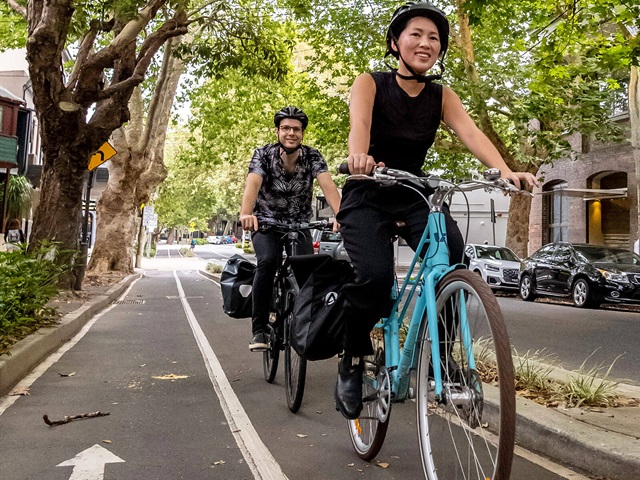
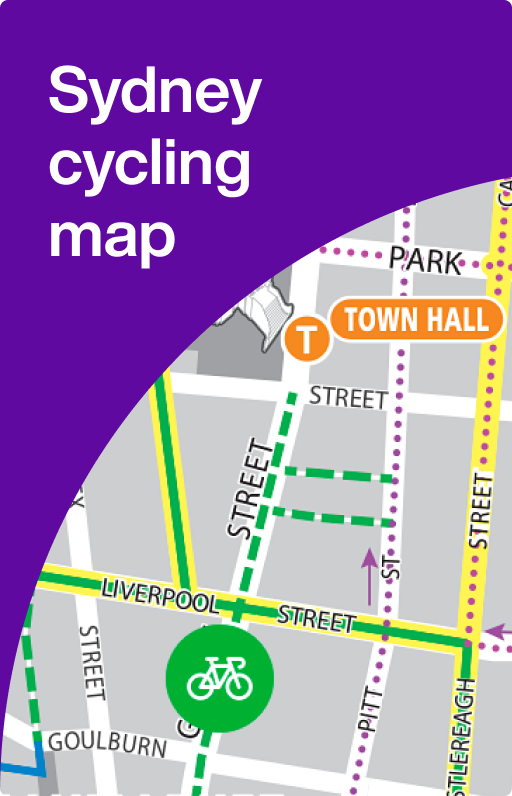
Explore our map to find out where can you park a shared bike.
Check your share bike company’s app to make sure you’re following parking rules. Bike share companies may issue a fine or ban if you don’t park correctly.
Guidelines for bike parking
Keep footpaths and building walls clear for people walking or travelling along the street.
Shared bikes can be moved if they’re blocking the way.
Parking bays
Micro-mobility parking bays are dedicated spaces, on a road or footpath marked with line markings, logos and, where needed, signs. Both private and shared bikes can be parked in these spaces.
When a new bay goes in, we ask bike companies to mark it in their app as an official parking spot and to restrict parking in the area around it to guide people who ride toward the bay instead of parking nearby. But this isn’t regulated and we can’t enforce this request.
Clustering bikes into share bike parking bays means fewer bikes blocking footpaths and doorways. It isn’t a perfect solution, but it significantly reduces the impact of share bike parking on public space, an approach that’s worked well in other cities.
As of July 2026, we have installed 85 on-road share bike parking bays and 166 on footpaths. There are 300 more planned by mid-2028. Each bay holds between 4 and 25 bikes, depending on its size.
If a concern is raised about a parking bay, we can redesign it or, in extreme cases, move it to a new location.
How we choose parking bays
We look for on-road locations first: spaces such as no stopping or parking zones that won’t take away from other kerbside uses like timed parking. If this isn’t possible, we sometimes convert other kerbside uses (such as parking) to micro-mobility parking bays. Off-road locations on the footpath or other public spaces are only used where no suitable on-road option is available, and we aim to minimise the impact on the footpath when we do.
Within this hierarchy, we prioritise:
- locations where high numbers of share bike trips start or end
- vibrant areas with high levels of footpath activity, where popular share bike demand needs stricter management of parking
- enough coverage – generally a parking bay within 100m – so bays are easy to use and can form connected controlled micro-mobility parking zones across an area
- locations that minimise impact on existing kerbside uses.
Reviewing proposed parking bays
Even though parking bays have a minor impact on our streets, we check the bays are safe and won’t block views of other people using the road, as well as for swept paths, grades and access. While we log our process, we don’t create in-depth reports as this would be an unnecessary drain on our resources.
Talking to our communities
When considering a proposal, how we consult our communities depends on the impact of the proposed micro-mobility parking bay.
No impact
Parking bays that don’t impact kerbside activities such as parking include no stopping, no parking and vacant car share bays. To notify the public, we’ll install signs for a minimum of 4 weeks.
Higher impact
These parking bays may impact car parking.
We ask the public for its feedback. Residents and ratepayers within 60m are informed in writing. The minimum feedback period is 3 weeks but we usually open it for 4. Feedback is provided to the Local Pedestrian, Cycling, Traffic Calming and Transport Forum, open to the public. We make a decision following the forum’s input.
Depending on budgeting, design and suppliers, a parking bay may be installed 1 to 6 months after approval.
Bike parking concerns
For badly parked or toppled share bikes, raise your concern with the company.